
PEG-MGF
A lab-made growth peptide sold for muscle. The FDA found no data from people using it. It is banned in sports.
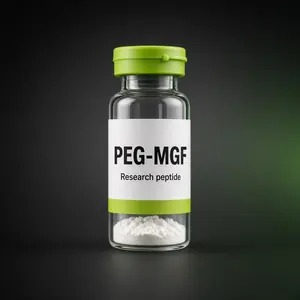
Not approved in the US. Taken off the FDA Category 2 list in April 2026, but not approved.
No study of PEG-MGF in people.
No data in people, says the FDA.
Three separate grades: the law (not approved), proof (none in people), and safety data (none in people). With no human data, both its benefits and its risks are unknown.
By the Peptide Science Desk Editorial TeamFact-checked against FDA and official sources · Not yet reviewed by a licensed clinician. How we check facts
What is it?
MGF (mechano growth factor) is a form of IGF-1 that muscles make when they are worked hard. "PEG" is a chemical tail added in a lab to make it last longer in the blood. PEG-MGF does not exist in the body.
Why do people use it?
Bodybuilders use it hoping to grow muscle or recover faster. The idea comes from muscle cells in dishes and mouse studies, not from people.
Does it really work?
Unknown. We found no study that gave PEG-MGF to people. In one human study, a hard leg workout raised the body’s own MGF signal in young adults, but not in adults over 70. That tells us about natural MGF, not about the lab product.
Related human data (no PEG-MGF studies in people)
We found 0 studies of PEG-MGF in people. The 3 rows below are related human data. None gave PEG-MGF to anyone.
| Study design | People | What they measured | What they found | Year | Journal | PubMed |
|---|---|---|---|---|---|---|
| Exercise study, muscle samples (not PEG-MGF) | 8 young and 7 older adults | The body’s own MGF signal after a hard workout | Rose in young adults, not in adults over 70. | 2003 | J Physiol | PMID 12562960 |
| Lab test of seized vials (not a treatment study) | No people treated | What was in confiscated vials | Found an MGF type (MGF R23H) in seized vials. | 2017 | Drug Test Anal | PMID 28035768 |
| Review of unregulated growth peptides | No new people | How much human evidence exists | Names PEG-MGF among products with no human studies. | 2026 | Front Endocrinol | PMID 42395176 |
Not in people yet
Muscle cells in a dish (2011) and mice with an ALS-like disease that got the MGF gene (2009) did better. Cell and mouse results often fail in people.
Is it safe? Side effects
- The FDA found no data from people using PEG-MGF.
- MGF is part of the IGF-1 family, a growth signal. Nobody has tested what extra amounts do to cancer risk.
- Anti-doping labs have found MGF types in seized vials. What is really inside a vial is unknown.
Is it legal in the US?
PEG-MGF is not an FDA-approved medicine.
- The FDA had put it on its "Category 2" list of risky pharmacy ingredients.
- In April 2026, it was moved off that list because the groups that asked about it withdrew their request. The FDA did not say it is safe.
- Plain MGF is on "Category 3," meaning people asked for it without enough support.
- On October 28, 2026, HHS issued a peptide policy for 6 other peptides. It does not cover PEG-MGF. WADA bans MGFs in sports.
What this means for PEG-MGF
Banned in sports? Drug tests
Banned in sports.
Yes. WADA bans PEG-MGF at all times, in and out of competition. It is in section S2.3 of the 2026 list: mechano growth factors (MGFs).
Talk to your doctor
If you want to build muscle, ask a doctor or trainer about strength training and protein. Those have real studies in people. PEG-MGF has none. We never share doses or tell you where to buy. Print our doctor questions sheet.
More questions
Does PEG-MGF build muscle?
No study in people has shown this.
Is PEG-MGF a steroid?
No. It is a lab-made peptide, not a steroid.
Is PEG-MGF FDA approved?
No. It is not an FDA-approved medicine.
Related peptides
- IGF-1 LR3Not approved · Proof: None found
- TB-500Not approved · Proof: Animal or lab only
- BPC-157Not approved · Proof: Early
Guides and tools
- FDA Category 2 Peptide List (2026): Which Peptides Are on It Now?Guide
- Drug test & sports ban checkerTool
- Compare PEG-MGF with another peptideTool
- Is my peptide source legit?Tool
- FDA warning letters trackerTool
Sources
- FDA: Bulk drug substances that may present significant safety risks
- FDA: Bulk drug substances nominated for 503A compounding (category lists, updated May 14, 2026)
- WADA: 2026 Prohibited List (sports anti-doping rules)
- FDA: Compounding and the FDA, Questions and Answers
- PubMed: Hameed et al., IGF-I splice variants (including MGF) in young and old muscle after exercise, J Physiol 2003
- PubMed: Cox et al., Detection of the confiscated peptides BPC 157 and MGF R23H, Drug Test Anal 2017
- PubMed: Review: Performance-enhancing peptides that act on the growth hormone system, Front Endocrinol 2026
- HHS: Enforcement Discretion Policy Regarding 503A Compounding Using Certain Peptide Bulk Drug Substances (Oct 28, 2026)
- Federal Register (public inspection): FR Doc. 2026-22192, HHS peptide compounding policy