
IGF-1 LR3
A changed, lab-made form of the growth signal IGF-1, sold for muscle. It is not approved, and it is banned in sports.
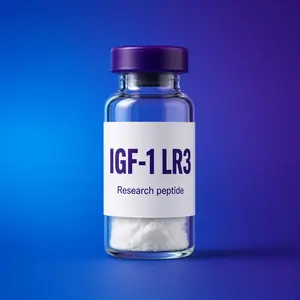
Not an FDA-approved medicine. This alone does not tell you if it works.
We found no study testing it as a treatment in people.
No safety data in people.
These are 3 different questions. FDA status is about the law. Proof is about whether it works. Safety data is about how much we know about its risks. A lack of safety data does not mean it does not work, and "not approved" does not mean "illegal."
By the Peptide Science Desk Editorial TeamFact-checked against FDA and official sources · Not yet reviewed by a licensed clinician. How we check facts
What is it?
IGF-1 LR3 is a lab-made, changed form of IGF-1. IGF-1 is a natural growth signal in your body. "LR3" stands for "Long R3," the name of the change.
Why do people use it?
Some bodybuilders use it hoping to build muscle. This is a claim. It is not a proven fact.
Does it really work?
We found no good studies testing IGF-1 LR3 as a treatment in people. A 2026 science review lists it among peptides people use on their own without approval. A real IGF-1 medicine, mecasermin (Increlex), is FDA-approved, but only for some children with a rare growth problem.
Studies in people
We found no published study that tested this in people. Animal and lab tests do not prove it works in people.
Is it safe? Side effects
- IGF-1 LR3 has no FDA label, so its side effects in people are not well known.
- The label for the approved IGF-1 medicine (Increlex) warns about low blood sugar, allergic reactions, and big tonsils. It says not to use it in children with cancer.
- It is banned in sports at all times.
Is it legal in the US?
IGF-1 LR3 is not an FDA-approved medicine.
- The only FDA-approved IGF-1 medicine is Increlex (mecasermin), and it is only for some children with a rare growth problem.
- IGF-1 and look-alikes are banned in sports at all times.
What "not approved" does and does not mean
- "Not FDA approved" is not the same thing as "illegal." It means the FDA has not reviewed proof that it works and is safe.
- Outside the narrow pharmacy rules below, selling it as a medicine for people breaks federal law. The FDA has warned companies that sold unapproved drugs labeled "for research" or "not for human consumption" to people. (FDA)
- A regular pharmacy may only mix (compound) a drug from a raw ingredient that has an official quality standard, is part of an FDA-approved drug, or is on the FDA’s 503A list. Big "outsourcing" pharmacies (503B) have their own list. (FDA)
- The FDA says that in most cases it is illegal for people to bring unapproved drugs into the US for their own use. (FDA)
- State rules differ. State boards of pharmacy oversee most pharmacies day to day. Sports leagues and the military have their own bans. (FDA)
Banned in sports? Drug tests
Banned in sports.
Yes. WADA bans IGF-1 LR3 at all times, in and out of competition. It is in section S2.3 of the 2026 list: "insulin-like growth factor 1 (IGF-1) and its analogues".
Talk to your doctor
Do not start any peptide on your own. Ask a doctor first. We never share doses or tell you where to buy. Print our doctor questions sheet.
More questions
Is IGF-1 LR3 the same as HGH?
No. It is a lab-made form of IGF-1, a different hormone than growth hormone.
Is IGF-1 LR3 the same as Increlex?
No. Increlex (mecasermin) is an FDA-approved IGF-1 medicine for some children with a rare growth problem. IGF-1 LR3 is not approved.
Is IGF-1 LR3 a steroid?
No. It is a protein-like peptide, not a steroid.
Related peptides
- PEG-MGFNot approved · Proof: None found
- MK-677 (ibutamoren)Not approved · Proof: Mixed
- Egrifta (tesamorelin)FDA approved · Proof: Strong
Guides and tools
- Drug test & sports ban checkerTool
- Compare IGF-1 LR3 with another peptideTool
- Is my peptide source legit?Tool
- FDA warning letters trackerTool